Cherry Audio Case Study - Electronic Music Course at Fullerton College
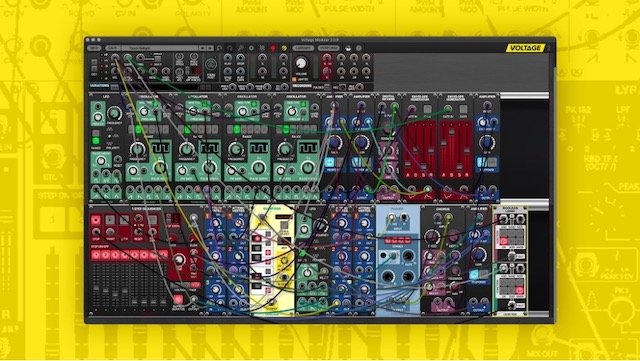
Prof. Markus Burger, Coordinator of Music Technology at Fullerton College, shares with us a case study on how Cherry Audio's virtual instruments and the Voltage Modular platform in Synth Stack 6 play a crucial role in the Electronic Music 1 course at Fullerton.
The Electronic Music 1 (EM1) course at Fullerton College serves as the foundational gateway for students exploring synthesis, sound design, and contemporary music production. The curriculum bridges historical synthesis principles with modern production workflows, requiring software that honors the tactile, hands-on roots of analog synthesis while delivering the cross-platform reliability demanded by the professional industry.
Academic Case Study: Integrating Cherry Audio Virtual Instruments into the Fullerton College Electronic Music 1 Curriculum
1. Introduction: The Fullerton College Electronic Music Context
The Electronic Music 1 (EM1) course at Fullerton College serves as the foundational gateway for students exploring synthesis, sound design, and contemporary music production. The curriculum bridges historical synthesis principles with modern production workflows, requiring software that honors the tactile, hands-on roots of analog synthesis while delivering the cross-platform reliability demanded by the professional industry.
Course Objective: The EM1 program cultivates a mindset of fearless experimentation. It equips students with tools that balance historical authenticity and modern stability, reducing barriers to complex sound design and supporting advanced learning outcomes.
2. The Educational Value of High-Fidelity Analog Emulation
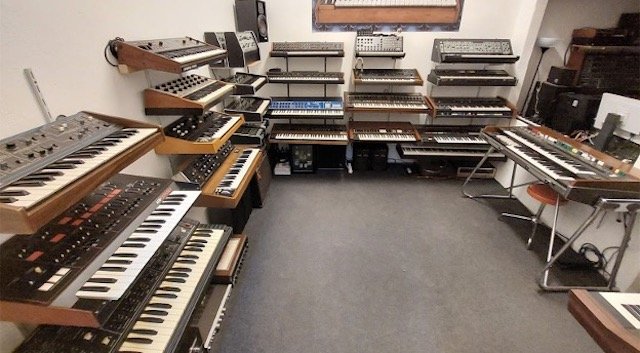
Standard digital synthesizers often fail to convey the subtle, non-linear behaviors of voltage-controlled components. Cherry Audio’s virtual instruments stand out through their rigorous, science-based modeling, offering superior pedagogical value over generic wavetable or FM plugins.
Cherry Audio’s modeling process demonstrates strong academic rigor:
Primary Research and Analysis: For the rare KORG PS-3300 (only 25–50 original units exist), Cherry Audio performed on-site research at the Electronic Music Education and Preservation Project (EMEAPP), including scientific audio recordings and circuit measurements to capture every harmonic detail.
Circuit-Level Fidelity: Developers meticulously analyzed envelope responses and original circuitry to replicate the distinctive “muscular” character of 1970s analog hardware.
Hardware-Software Integration: Bi-directional MIDI SysEx support in instruments like the Mercury-8 (Roland Jupiter-8 emulation) and Rhodes Chroma enables seamless patch exchange between software and original hardware—teaching students practical concepts in future-proofing and hybrid workflows.
3. Core Teaching Tools: Specific Applications in Electronic Music 1
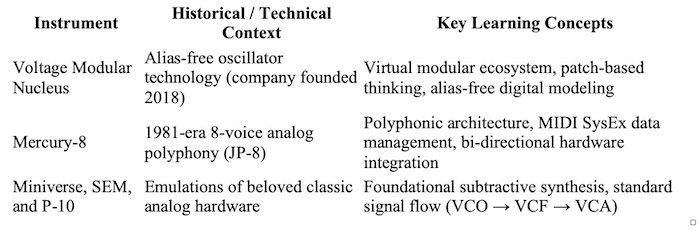
The following table maps key Cherry Audio instruments to their primary pedagogical roles in the EM1 curriculum:
4. Advanced Synthesis and Visual Pedagogy with Sines
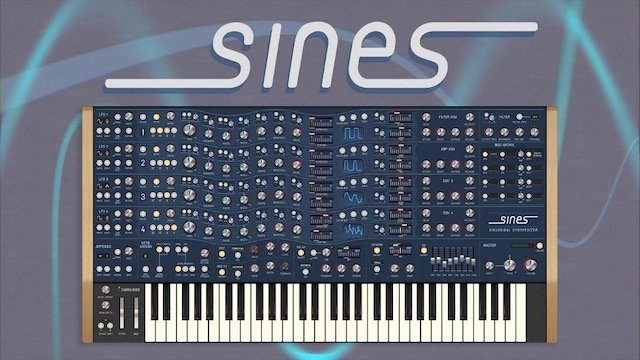
Sines serves as the primary bridge from traditional subtractive synthesis to “West Coast” and FM techniques. Unlike vintage emulations, Sines is an original polyphonic design that starts from pure sine waves and encourages deep exploration of tone construction.
Classroom Benefits
Visual Feedback — Each of the four oscillators includes a miniature oscilloscope, giving students immediate visual confirmation of how waveshaping parameters (Feedback, Phase, Width, Shape, Wavefold, and Drive) sculpt harmonic content.
FM Accessibility — Intuitive Ratio-based tuning simplifies 1980s-style four-operator FM synthesis. Built-in presets recreate all classic Yamaha four-op FM algorithms, letting students explore iconic digital timbres without archaic interfaces.
Complex Modulations — The deep modulation matrix allows oscillators to function as both carriers and modulators, helping students connect additive, waveshaping, and phase-modulation concepts.
5. Standardized User Experience and Student Accessibility
Cherry Audio’s clean, consistent user interface minimizes technical friction. All critical parameters remain visible without hidden menus or tabs—ideal for students still internalizing signal paths.
Workflow and Equity Features
Visual Equity — The Focus button enlarges the interface for students working on small 13-inch laptops, ensuring equal access regardless of hardware.
Experimental Safety — Robust Undo/Redo functionality encourages bold experimentation by allowing quick recovery from “loused up” patches.
Professional Skills — The Preset Browser, with collections, categories, and keyword search, builds essential asset-management habits used in the music industry.
Accessibility & Privacy — Pre-purchase demo mode lets students complete assignments before buying (with only occasional inharmonic tones as a watermark). Essential cookies support compliance with student data privacy standards.
6. Technical Support and Community Resources
Students are encouraged to use Cherry Audio’s official resources for self-directed learning:
Community Forums for peer troubleshooting and synthesis discussions
Kayako professional tech support portal
Comprehensive, well-documented user guides for every instrument
These channels provide reliable support beyond classroom hours.
7. Summary of Curricular Impact
Integrating Cherry Audio virtual instruments into the Fullerton College Electronic Music 1 curriculum equips students with intuitive, professional-grade tools that sound exceptional and function reliably. By dramatically lowering economic and technical barriers to advanced synthesis, the program empowers learners to evolve from novices into confident musicians and creative professionals.
This integration keeps the art of sonic experimentation at the heart of the curriculum, preparing graduates for the demands of today’s music industry.